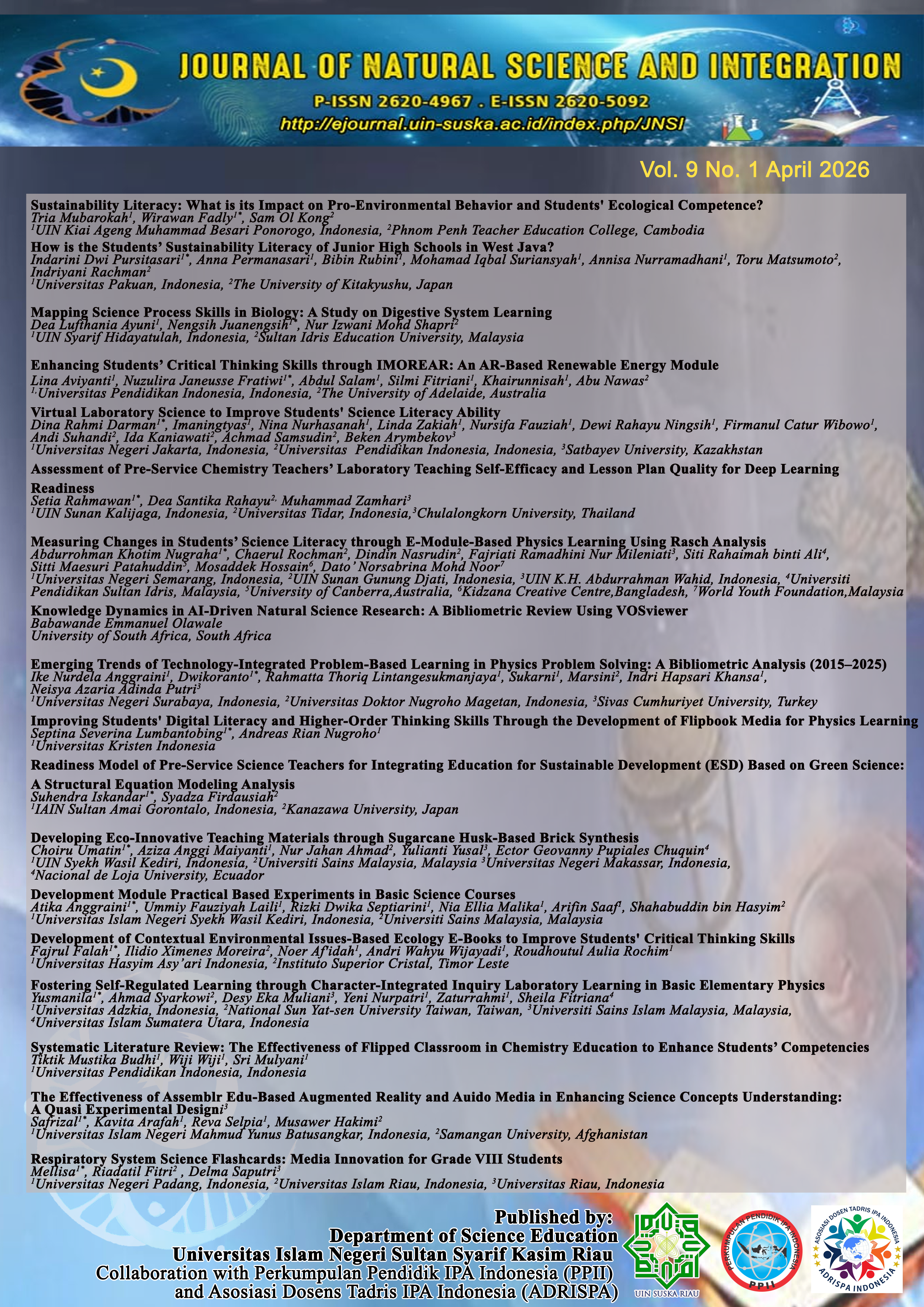
Development of Contextual Environmental Issues-Based Ecology E-Books to Improve Students' Critical Thinking Skills
DOI:
https://doi.org/10.24014/jnsi.v9i1.39257Abstract
This research aims to develop a valid and effective contextual environmental issue-based ecology e-book to improve students' critical thinking skills. This research uses a Research and Development (R&D) approach with a 4D (Define, Design, Develop, Disseminate) model. The research population consists of junior high school students, and the test subjects (as the unit of analysis) comprise 61 grade VII students from two classes. This sample size was selected to ensure data representativeness and to more comprehensively measure the effectiveness of the media. Data collection techniques include validation sheets by subject matter experts, media experts, and science teachers, as well as pretest and posttest instruments based on critical thinking indicators. Data were analyzed using descriptive statistics, N-Gain analysis, and classical learning mastery percentage. The validation results showed an average score of 3.70, indicating high feasibility. The effectiveness test results showed an increase in the average score from 55 to 75, with an N-Gain of 0.44 (medium), and an increase in classical learning mastery from 31% to 85%. This study offers novelty by systematically mapping six critical thinking indicators into the interactive features of the e-book that specifically address local environmental issues. Thus, the developed e-book is highly feasible and proven to be effective as an innovative independent teaching material in science learning. Keywords: ecology e-book, contextual environmental issues, critical thinking skillsReferences
Afriandi, M. (2021). Development of Booklets Integrated with Islamic Values as A Learning Resource For Natural Science. Journal of Natural Science and Integration, 4(2), 101–114. https://ejournal.uin-suska.ac.id/index.php/JNSI/article/view/28782
Agnesa, O. S., & Rahmadana, A. (2022). Problem-based Learning Model as An Effort to Improve Critical Thinking Skills in Biology Learning. JOTE: Journal on Teacher Education, 3(3), 65–81. https://doi.org/10.31004/jote.v3i3.4384
Amanda, D., Fajrina, S., Razak, A., & Darussyamsu, R. (2025). Development of a SETS-Based E-Module to Enhance Critical Thinking Skills on Environmental Change. JPBI (Jurnal Pendidikan Biologi Indonesia), 11(3), 859–873. https://doi.org/10.22219/jpbi.v11i3.41221
Andhani, N. D., Ningsih, K., & Tenriawaru, A. B. (2021). Feasibility of LKPD Based on Guided Inquiry on Class X Invertebrate Submatter. Journal of Natural Science and Integration, 3(1), 87–98. https://doi.org/10.24014/jnsi.v3i1.9161
Arda, A. (2024). A Review of Students’ Critical Thinking Skills in Science Learning in Indonesia. JPMIPA, 1–22. https://jpmipa.fkip.unila.ac.id/index.php/jpmipa/article/view/150
Defianti, A. (2023). Development of An E-Module Guideline on Basic Physics for Senior High School. Journal of Natural Science and Integration. https://ejournal.uin-suska.ac.id/index.php/JNSI/article/view/15595
Dwiyanti, P. B. (2021). E-book Based Problem-Based Learning to Improve Students’ Critical Thinking in Science Learning in Elementary School. Jurnal PGSD Universitas Negeri Jakarta. https://journal.unj.ac.id/unj/index.php/pgsd/article/download/53035/19994/156689
Erfariyah, A. (2024). Development of Conservation E-Books Based on Local Potential to Improve Eco-Literacy of Junior High School Students. https://ipa-pasca.unpak.ac.id/pdf/publikasi_ilmiah/ai-erfariah-development-of-conservation-e-books.pdf
Erfariyah, A., Jaenudin, D., & Permana, I. (2024). Development of Conservation E-Books Based on Local Potential to Improve Eco-Literacy Of Junior High School Students. International Journal of STEM Education for Sustainability, 4(2), 267–292. https://doi.org/10.52889/ijses.v4i2.443
Falah, F., Indana, S., & Tukiran. (2021). Validity and practicality of learning resources flipbook identification of Basidiomycota mushrooms for senior high school students. International Journal of Recent Educational Research (IJORER), 2(6). https://doi.org/10.46245/ijorer.v2i6.174
Falah, F., Rochim, R. A., & Wijayadi, A. W. (2025). The effectiveness of a flipbook-type e-book for Basidiomycota fungus identification to train students’ learning motivation. Discovery: Journal of Science. https://ejournal.unhasy.ac.id/index.php/discovery/article/view/8732
Fitanti, S. Y., Prahani, B. K., Suryanti, S., & Saphira, H. V. (2025). Optimization of digital game media in game-based learning to improve critical thinking skills. JPPS: Jurnal Penelitian Pendidikan Sains, 14(2), 227–242. https://doi.org/10.26740/jpps.v14n2.p227-242
Fithriatiz Zahro, L., Lestari, N. A., & Sya’roni, I. (2025). Effectiveness of physics learning with PBL model assisted by 3D webbook integrated with environmental learning to improve students’ critical thinking skills. JPPS: Jurnal Penelitian Pendidikan Sains, 14(2), 157–172. https://doi.org/10.26740/jpps.v14n2.p157-172
Hadi, A. S. (2021). Developing an interactive flipbook to enhance student engagement in science learning. Journal of Natural Science and Integration, 3(1), 45–59. https://doi.org/10.24014/jnsi.v3i1.9036
Hadi, A. S. (2025). Development of an interactive flipbook to enhance student engagement in science learning. Journal of Natural Science and Integration. https://ejournal.uin-suska.ac.id/index.php/JNSI/article/view/34901
Hajar, I., Mel, M., & Ferazona, S. (2025). Implementation of discovery learning model to improve students’ collaborative skills in biology learning. Journal of Natural Science and Integration, 8(1), 190–200. https://ejournal.uin-suska.ac.id/index.php/JNSI/article/view/35541
Jamaludin, A. J. (2023). Problem-based learning development to increase student engagement in science. Journal of Natural Science and Integration, 7(2), 199–214. https://ejournal.uin-suska.ac.id/index.php/JNSI/article/view/13279
Kustantia, E., Miarsyah, M., & Sigit, D. V. (2023). Enhancing student conceptual understanding and critical thinking through SETS-based digital modules on environmental changes. JPBI (Jurnal Pendidikan Biologi Indonesia), 9(3), 359–370. https://doi.org/10.22219/jpbi.v9i3.28418
Lesmanawati, I. R. (2024). Development of e-pocket book learning media on environmental pollution in Cirebon. Journal of Education. https://doi.org/10.25157/jpbi.vxxi2.29356
Maulida, Q. (2024). Literature review of interactive e-book-based learning media in science learning. Inspirasi-JPK. https://jurnal.sinesia.id/index.php/Inspirasi-JPK/article/download/163/62
Mukminin, C. (2021). The effect of the use of e-book learning media on science learning outcomes in grade VII. https://www.researchgate.net/publication/378269860
Noviana, R., Limiyati, N., & Darmiasih, D. (2023). Application of a problem-based learning model to improve student learning outcomes in ecology. Bioed: Jurnal Pendidikan Biologi, 11(2), 113–128. https://doi.org/10.25157/jpb.v11i2.10413
OECD. (2019). PISA results in focus: 2018 edition. OECD Publishing. https://www.oecd.org/pisa/
Purwanto, H. (2020). Implementation of problem-based learning to improve students’ scientific attitudes and cognitive learning outcomes. Journal of Natural Science and Integration, 5(3), 123–140. https://ejournal.uin-suska.ac.id/index.php/JNSI/article/view/9355
Wahyuning, R., & Subandowo, M. (2022). Development of e-book learning media to improve science knowledge in children aged 4–5 years. JIPI, 7(2), 271–282. https://doi.org/10.29100/jipi.v7i2.2714
Wibisari, G. Z., & Mulyani, P. K. (2023). Development of e-book-based science teaching materials as a learning medium for grade V elementary school. Prima Magistra: Jurnal Ilmiah Kependidikan, 4(4), 509–521. https://doi.org/10.37478/jpm.v4i4.3034
Wicaksono, I., Farros, M. H., Salleh, S. M., Chen, Y. C., & Nuha, U. (2025). Development of contextual-based e-comic learning media to improve students’ critical thinking skills. JPPS: Jurnal Penelitian Pendidikan Sains, 14(2), 80–107. https://doi.org/10.26740/jpps.v14n2.p80-107